GEOTECHNICAL ENGINEERING
NEWBRIDGE
HomeSlopes & WallsActive/passive anchor design

Active and Passive Anchor Systems in Newbridge

Knowledgeable. Thorough. Resourceful.

LEARN MORE

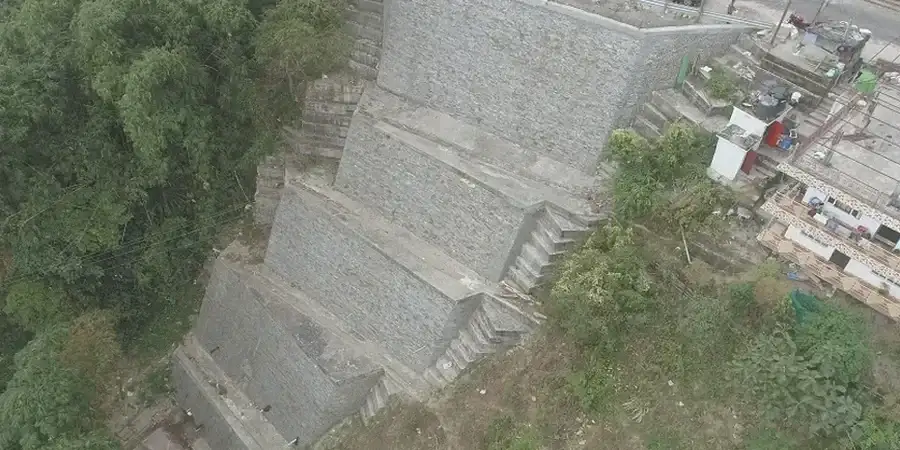
Newbridge grew up around the River Liffey and the military barracks, but the real expansion came with the Kildare shopping outlet and the commuter belt pressure from Dublin. That growth pushed construction onto the floodplain edges and into the glacial till that blankets the area. What we see now are apartment blocks and commercial units cut into gentle slopes where you need to hold back 4 to 6 metres of ground. Active and passive anchor design becomes the quiet backbone of those projects. The till here is dense but it can be bouldery, with lenses of sand that complicate drilling. A straightforward soldier pile wall often needs a deep excavation strategy that accounts for variable overburden and water ingress. In Newbridge, anchoring is less about height and more about precision in ground with an unpredictable memory.

In Newbridge glacial till, the difference between an active and passive anchor is often the tolerance for movement of the building next door.
Our service areas

How we work

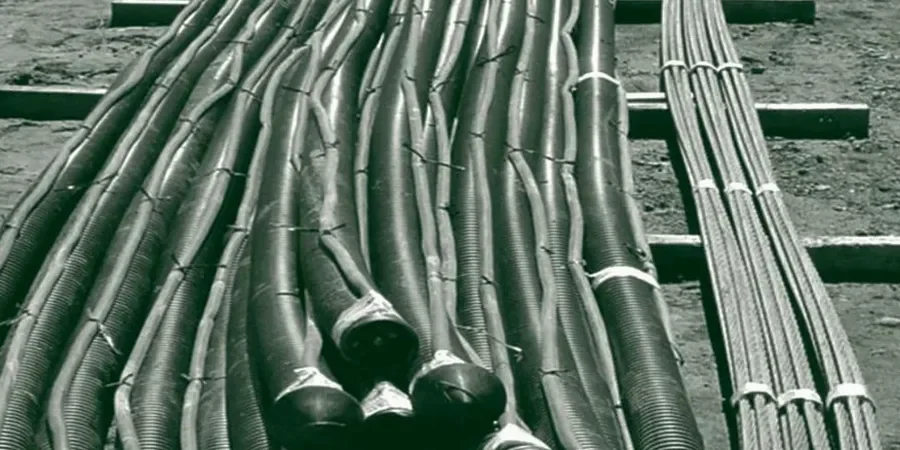
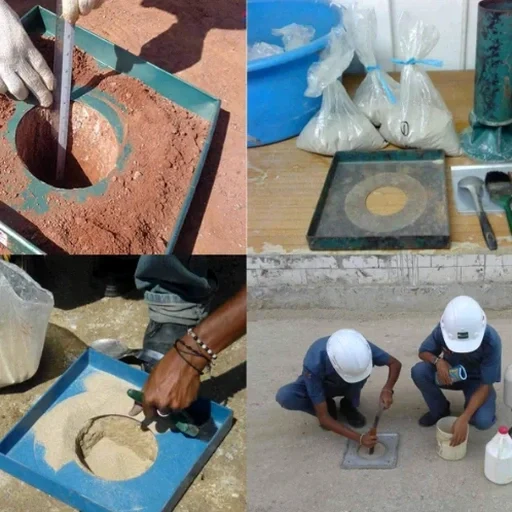
Newbridge sits at roughly 90 metres above sea level, on the northern edge of the River Liffey floodplain. The local subsoil is predominantly Irish glacial till—a mix of clay, sand, gravel, and cobbles deposited during the last glaciation. What matters for anchor design is that this till is overconsolidated, meaning it stands well in the short term but can relax with time if not properly restrained. Active anchors are tensioned immediately to preload the structure; passive anchors engage only as the wall moves. In the till we see in Newbridge, passive anchors often suit restrained conditions where movement can be tolerated, while active anchors are specified for sensitive neighbouring structures. Our design process always follows IS EN 1997-1:2005, with particular attention to the ultimate bond stress values derived from site-specific pull-out tests. Limestone bedrock is typically met between 6 and 12 metres depth, offering a reliable fixed anchor zone when needed.
Active and Passive Anchor Systems in Newbridge
Technical reference — Newbridge

Local considerations

A few years ago, a mixed-use development on a sloping site near the Liffey ran into trouble when a contractor tried to use a gravity wall where a tied-back system was needed. The till looked competent in the trial pit, but after heavy rain the slope began to creep. We designed a row of passive anchors to stabilise the wall, and the movement stopped within 48 hours of installation. That case is typical for Newbridge: the till is strong, but water softens the matrix and reduces bond. The biggest risk we see is underestimating the groundwater perched within the till lenses. We always specify injection boreholes with a water-pressure test before anchor installation. Without that, a perfectly designed anchor can fail at the grout-to-ground interface. Corrosion is another silent issue—sulphate-rich groundwater in parts of Newbridge means we default to double corrosion protection unless a site-specific risk assessment proves otherwise.

Need a geotechnical assessment?

Reply within 24h.

Email: contact@geotechnical-engineering.co

Applicable standards

IS EN 1997-1:2005 (Eurocode 7: Geotechnical design), IS EN 1537:2013 (Execution of special geotechnical works: Ground anchors), I.S. EN 1990:2002 (Basis of structural design), Specification for Highway Works (NRA, Ireland)

Technical data

ParameterTypical value
Anchor typeActive (pre-stressed) and passive (reactionary)
Design standardIS EN 1997-1:2005 (Eurocode 7)
Typical anchor length in Newbridge8 to 18 metres
Typical anchor capacity200 to 800 kN per strand
Fixed anchor zone targetLimestone bedrock or dense basal till
Proof testing1.25 x design load (active anchors)
Corrosion protectionDouble corrosion protection (DCP) in aggressive soils

Common questions

What is the typical cost range for an anchor design package in Newbridge?

For a complete anchor design package including calculations, drawings, and on-site testing supervision, the cost in Newbridge ranges from €1000 to €3310, depending on the number of anchor rows, the complexity of the ground profile, and whether proof testing is included.

What is the difference between active and passive ground anchors?

Active anchors are tensioned immediately after installation to apply a pre-load to the structure, preventing movement before excavation proceeds. Passive anchors are not pre-stressed; they engage only when the wall or slope begins to move. The choice depends on the allowable displacement of the retained structure and the proximity of neighbouring buildings.

How deep do anchors typically need to go in Newbridge soil conditions?

In Newbridge, anchor lengths typically range from 8 to 18 metres. The fixed length must extend beyond the critical failure surface and, ideally, into the limestone bedrock or very dense basal till. We determine the exact bond length through pull-out tests on site.

Which building regulations apply to anchor design in Ireland?

Anchor design in Ireland must follow IS EN 1997-1:2005 (Eurocode 7) for geotechnical design and IS EN 1537:2013 for ground anchor execution. The National Annex for Ireland provides additional parameters. We also reference the NRA Specification for Highway Works when the work is near public roads.

Location and service area

We serve projects in Newbridge and surrounding areas.

View larger map