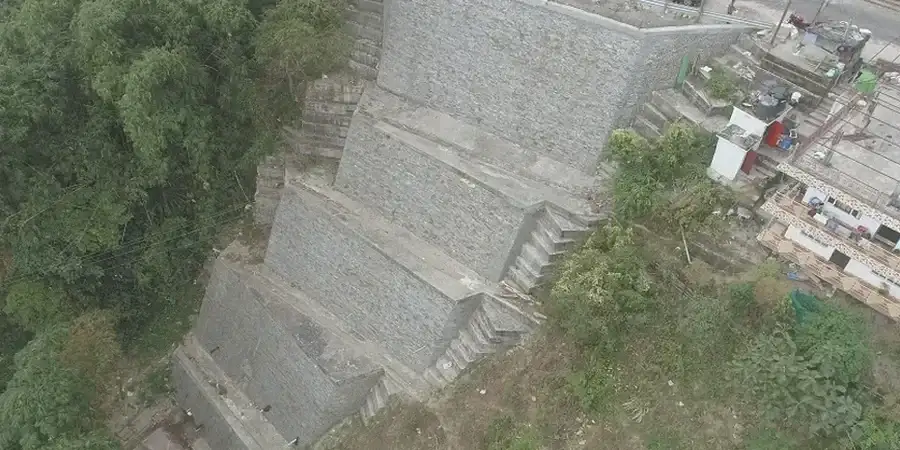
GEOTECHNICAL ENGINEERING
NEWBRIDGE
HomeIn-Situ TestingField density test (sand cone method)

Field Density Testing in Newbridge: Precision Soil Compaction Verification

Knowledgeable. Thorough. Resourceful.

LEARN MORE

The expansion of Newbridge along the River Liffey corridor, particularly the recent housing developments north of the town centre, has pushed earthworks onto the variable glacial tills that define Kildare's subsoil. This till, a legacy of the Midlandian glaciation, alternates between stiff boulder clay and pockets of softer, more compressible material; a contractor cannot assume uniformity across a single site. The sand cone density test brings certainty to that picture, providing a direct measurement of in-place density that ties immediately to the relative compaction specification. Where a plate load test is needed for modulus-based acceptance of the formation, the sand cone remains the method of choice for verifying the layer-by-layer compaction of cohesive and granular fills under Irish Standard IS EN 13286-2. Our laboratory runs these checks across Newbridge from the College Farm Road business parks to the new residential zones off the Curragh Road, delivering results within the working day so that the next lift can proceed without delay.

A sand cone test converts an assumption about compaction into a number: percent relative compaction against a Proctor reference, on site, within 30 minutes.
Our service areas

How we work

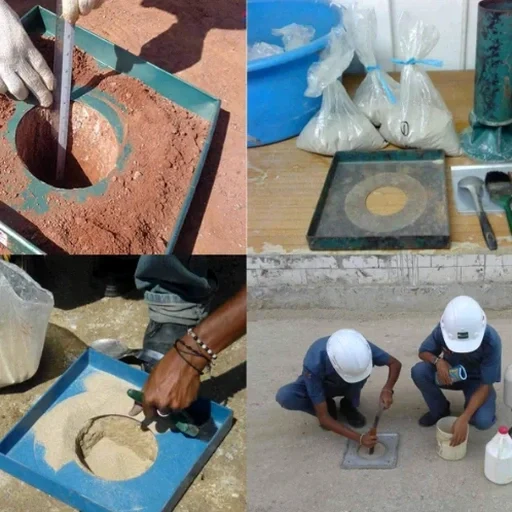
Kildare's inland climate, with its sharp winter frosts and damp autumns, directly influences compaction control schedules. A fill that passed density testing in dry September weather can fail after a week of October rain if moisture conditioning was not adjusted. The sand cone method excels in these conditions because it is not sensitive to the aggregate interlock problems that frustrate nuclear gauges in stony glacial till. A technician excavates a clean, undisturbed hole through the compacted layer, retrieves all the material, and replaces the volume with calibrated Ottawa sand from a single-cone apparatus. The mass of the excavated soil, divided by the volume of sand required to fill the cavity, gives the wet density; a Speedy moisture test on site then corrects it to dry density. That dry density is compared against the laboratory maximum dry density from a Proctor curve, yielding a percent compaction figure that the resident engineer can sign off immediately. When the specification calls for a deeper understanding of the fill material itself, we complement the field test with a grain size analysis on the recovered sample to confirm that the grading envelope still matches the approved borrow source.
Field Density Testing in Newbridge: Precision Soil Compaction Verification
Technical reference — Newbridge

Local considerations

Newbridge sits at approximately 90 metres above ordnance datum on the eastern edge of the Curragh plain, an area where the water table can rise rapidly in winter months. A compacted fill that achieved 95% relative compaction in November may still suffer settlement if groundwater later softens the underlying natural clay; density testing alone cannot detect this deeper risk profile. The most consequential failures we see in the Newbridge area involve service trench backfill: a rush to reinstate before a housing estate opens, inadequate layer thickness, and a skipped density test lead to differential settlement within 18 months. The longitudinal cracking that follows along road edges is expensive to repair and completely avoidable. For larger earthworks platforms where groundwater is a known concern, the density testing programme should be accompanied by a slope stability assessment if the site includes permanent batters or retention features that will be subject to long-term pore pressure changes.

Need a geotechnical assessment?

Reply within 24h.

Email: contact@geotechnical-engineering.co

Applicable standards

IS EN 13286-2:2010 — Unbound and hydraulically bound mixtures: Test methods for dry density and water content, NRA RCD 500-7 — Specification for Road Works: Earthworks and drainage layers, IS EN 1997-2:2007 — Eurocode 7: Geotechnical design: Ground investigation and testing, BS 1377-9:1990 — Methods of test for soils for civil engineering purposes: In-situ density tests (sand replacement method, referenced for method detail)

Technical data

ParameterTypical value
Test standardIS EN 13286-2:2010 + NRA RCD 500-7
Hole diameter100–150 mm (adjusted for max particle size)
Calibration sandUniform Ottawa sand, calibrated daily
Measurement typeDirect volume replacement, gravimetric density
Moisture determinationSpeedy moisture tester or oven-dry on retained sample
Result expressionDry density (Mg/m³) and % relative compaction
Typical test depthSingle compacted lift, typically 150–300 mm

Common questions

How much does a field density test using the sand cone method cost in Newbridge?

A single sand cone density test on a residential or commercial site in the Newbridge area typically falls between €90 and €110, depending on site access and the number of tests scheduled on the same day. A full day of compaction testing with multiple points and immediate reporting is priced by agreement based on the specification requirements.

What standard governs the sand cone density test in Ireland?

The primary standard is IS EN 13286-2:2010, which specifies the test methods for determining the dry density and water content of unbound and hydraulically bound mixtures. For roadworks, the NRA Manual of Contract Documents for Road Works (RCD 500-7) provides the specification for frequency and acceptance criteria. The detailed method for sand replacement is also described in BS 1377-9:1990, which remains the practical reference for site technicians.

How many density tests do I need per lift on a typical Newbridge housing site?

The standard frequency under NRA RCD 500-7 is one test per 500 m² per compacted lift, with a minimum of three tests per area of operation. For service trench backfill, the requirement is typically one test every 30 linear metres or per lift per trench section. These frequencies can be adjusted based on the material variability and the engineer's assessment of risk.

Can the sand cone method be used on coarse granular fill with large stones?

The sand cone method is reliable for materials with a maximum particle size up to approximately 37.5 mm. If the fill contains larger cobbles or boulders, the excavated hole becomes irregular and the sand volume measurement loses accuracy. In those cases we increase the hole diameter to at least four times the largest particle size or switch to a water replacement method where the specification allows.

Location and service area

We serve projects in Newbridge and surrounding areas.

View larger map