GEOTECHNICAL ENGINEERING
NEWBRIDGE
HomeGeophysicsElectrical resistivity / VES (Vertical Electrical Sounding)

Electrical Resistivity Testing (VES) in Newbridge, Kildare

Knowledgeable. Thorough. Resourceful.

LEARN MORE

Between the flat, sandy plains near the Curragh and the wetter lowlands approaching the Liffey, Newbridge sits on a geological boundary that catches out more than one ground investigation. The contrast is stark. Dry, free-draining gravels in one estate. Soft, saturated clay in the next. Resistivity testing cuts through that guesswork. We run Vertical Electrical Sounding (VES) to map the vertical layering without opening the ground. In a town where housing estates and commercial units keep pushing west, knowing what lies beneath the asphalt before the excavator arrives saves weeks of delay. We combine VES with test pits when we need a physical check on the top two metres, but the resistivity profile gives us the full sequence down to bedrock.

Resistivity mapping across Newbridge limestone gives us the rockhead profile without drilling every twenty metres.
Our service areas

How we work

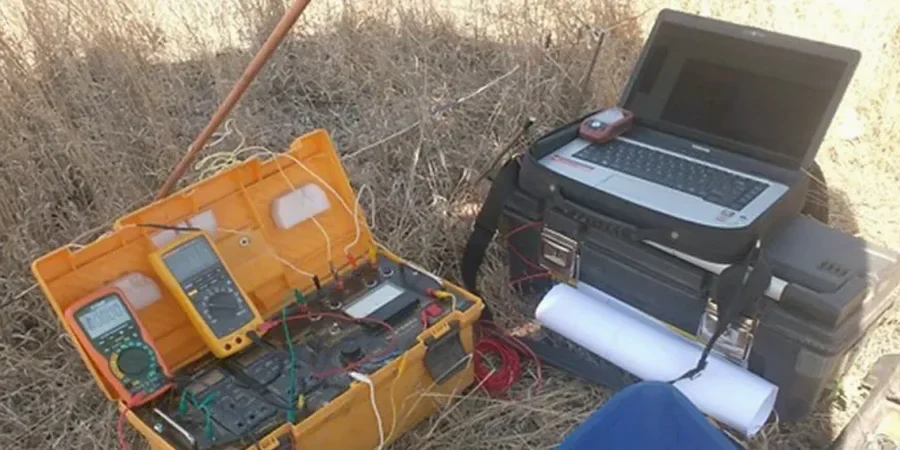
The kit we deploy around Newbridge is a 4-electrode Schlumberger array powered by a regulated transmitter. We drive stainless steel stakes into the grass or hard shoulder and expand the current electrode spacing step by step. Each measurement point yields an apparent resistivity value. The inversion software resolves that into true layer resistivities and thicknesses. In the limestone terrain south of the town centre, the resistivity contrast between the overburden and the rockhead is sharp—typically a jump from 60–120 Ωm in the glacial till to 400–800 Ωm in the competent limestone. On the Curragh sands, the numbers shift completely: dry sand can read above 1,000 Ωm, while the perched water table drops it below 80 Ωm. We calibrate against borehole logs and water strikes whenever available, keeping the interpretation grounded, not theoretical.
Electrical Resistivity Testing (VES) in Newbridge, Kildare
Technical reference — Newbridge

Local considerations

The mistake we keep seeing in Newbridge is assuming the bedrock is uniform because the site is flat. Developers take one borehole log, extrapolate it across the whole plot, and then find a karst depression full of soft clay right where the attenuation tank was planned. The Curragh monocline structure means the limestone can drop several metres over a short distance. A single VES line of four or five soundings picks up that variation in an afternoon. Another classic error is ignoring seasonal groundwater fluctuation. A resistivity survey run during a dry August will show a different water table signature than one run in February. We flag that in the report—resistivity is a snapshot, and the interpretation has to account for the season and recent rainfall. Ignore it, and you design a basement waterproofing system for conditions that only exist three months of the year.

Need a geotechnical assessment?

Reply within 24h.

Email: contact@geotechnical-engineering.co

Applicable standards

I.S. EN 1997-2:2007 (Eurocode 7, Part 2: Ground investigation and testing), BS 5930:2015 + A1:2020 (Code of practice for ground investigations), NSAI I.S. 297:2015 (Recommendations for site investigations), IAH / GSI guidance on karst terrain assessment

Technical data

ParameterTypical value
Array configurationSchlumberger (standard), Wenner (shallow targets)
Maximum investigation depth30–60 m depending on terrain access
Typical electrode spacing (AB/2)1.5 m to 100 m
Apparent resistivity range5–5,000 Ωm
Data processing1D inversion with layer smoothing
OutputResistivity-depth profile, layer thickness table, interpreted lithology
Measurement time per VES30–60 minutes per sounding point
Applicable standardI.S. EN 1997-2:2007, BS 5930

Common questions

What does a VES survey cost for a standard residential site in Newbridge?

For a single-house plot or small extension, a VES survey with two to three sounding points typically runs between €620 and €820 plus VAT. The exact figure depends on access, the number of soundings, and whether we need to combine it with trial pits or boreholes to calibrate the resistivity model.

How deep can you see with the resistivity method around Newbridge?

With the Schlumberger array and enough room to expand the current electrodes, we routinely reach 30 to 40 metres depth. In open fields on the edge of town, 50 to 60 metres is achievable. The limiting factor is usually the site boundary, not the equipment. We need roughly three to four times the target depth in electrode spread length.

Can resistivity tell the difference between saturated sand and clay?

Yes, and that is one of the main reasons we use it on Newbridge sites. Clay holds ions and conducts electricity well, giving low resistivity values, often below 20 Ωm. Clean saturated sand or gravel reads much higher, typically 50 to 150 Ωm depending on the water chemistry. The contrast is clear enough that we can map the boundary between the Curragh sands and the underlying boulder clay with good confidence.

Location and service area

We serve projects in Newbridge and surrounding areas. More info.

View larger map