GEOTECHNICAL ENGINEERING
NEWBRIDGE
HomeLaboratoryTriaxial test

Triaxial Testing for Kildare Construction Projects

Knowledgeable. Thorough. Resourceful.

LEARN MORE

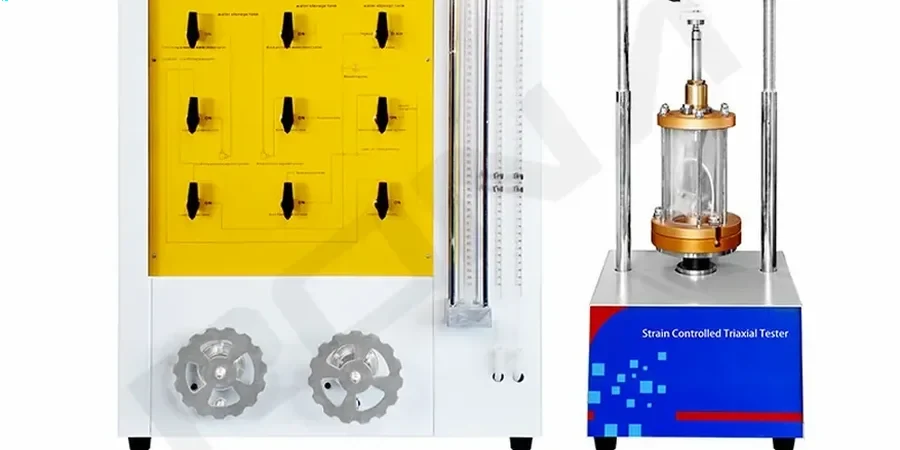
Newbridge sits on a complex mix of glacial tills and underlying Carboniferous limestone. The River Liffey cuts through the town, and groundwater can be high along its banks. This geology demands precise shear strength data. A standard penetration test gives index values. It does not measure effective stress. For foundation design and slope analysis we run the triaxial test. We need intact samples. The sampling disturbance must be minimal. Our lab in Newbridge processes Shelby tubes and block samples. The triaxial test measures cohesion and friction angle under controlled drainage. These parameters feed directly into Eurocode 7 design. For sites with soft alluvial deposits near Newbridge, we often pair the triaxial test with in-situ permeability to understand drainage conditions during consolidation.

Effective stress parameters from a triaxial test are not an academic exercise. They are the difference between a safe foundation and a serviceability failure in Kildare's glacial tills.
Our service areas

How we work

The expansion of Newbridge in the 19th century, driven by the cavalry barracks and the Grand Canal, placed early structures on compact glacial till. Modern development pushes into the floodplain and onto weaker lacustrine clays. This shifts the geotechnical risk. We perform consolidated-undrained triaxial tests with pore pressure measurement. The effective stress path is plotted. We define the critical state line. For granular soils from the Curragh gravels, we run consolidated-drained tests. Volume change is recorded. The peak and critical state friction angles are then derived. These results are essential when assessing slope stability along the Liffey valley, where pore pressure build-up can trigger failure in cut slopes. Our laboratory follows the procedures set out in I.S. EN ISO 17892-8:2018 for the unconsolidated undrained triaxial compression test and I.S. EN ISO 17892-9 for consolidated triaxial tests.
Triaxial Testing for Kildare Construction Projects
Technical reference — Newbridge

Local considerations

The mean elevation of Newbridge is about 90 metres above sea level, but foundation levels near the river can be much lower. Ignoring effective stress can lead to two problems. First, underestimating settlement in normally consolidated clays. Second, overestimating short-term stability in excavations. A total stress analysis from a simple undrained test may be conservative or unsafe depending on the drainage path. The triaxial test resolves this. It simulates field conditions. We consolidate the sample to the in-situ stress state. Then we shear it. The pore pressure response is measured directly. For a deep excavation in Newbridge town centre, this data prevents basal heave. When combined with excavation monitoring, the design can be validated during construction with real-time inclinometer and piezometer readings.

Need a geotechnical assessment?

Reply within 24h.

Email: contact@geotechnical-engineering.co

Applicable standards

I.S. EN ISO 17892-8:2018 (Unconsolidated undrained triaxial test), I.S. EN ISO 17892-9:2018 (Consolidated triaxial tests), Eurocode 7: EN 1997-2 (Ground investigation and testing)

Technical data

ParameterTypical value
Specimen diameter38, 50, 70, or 100 mm
Specimen height-to-diameter ratioTypically 2.0
Maximum deviator stress (q)Up to 2 MPa (soil dependent)
Confining pressure range50 kPa to 800 kPa
Pore pressure measurementBack pressure saturation method
Rate of axial displacement0.001 to 0.1 mm/min (drained/undrained)
Test stagesSaturation, consolidation, shear
Reported parametersc', φ', c_u, E_u, K_0, stress path

Common questions

What is the typical cost range for a triaxial test programme in Newbridge?

A standard set of three triaxial tests (usually one multi-stage or three single-stage) with full reporting typically falls between €1,470 and €2,180. The final cost depends on the number of confining pressures, the type of test (UU, CU, CD), and whether advanced stress path control is required.

How long does it take to get results from a triaxial compression test?

A consolidated-undrained or drained test on a fine-grained soil can take 1 to 2 weeks. The consolidation phase itself may require 24 to 72 hours depending on the soil's permeability. We provide preliminary effective stress plots as soon as the shear phase is complete, ahead of the full factual report.

Which type of triaxial test is right for my project?

For short-term stability of an excavation in clay, a consolidated-undrained (CU) test with pore pressure measurement is standard. For long-term settlement or slope analysis, a consolidated-drained (CD) test is used. We review your borehole logs and site description to recommend the correct test type during the proposal phase.

Location and service area

We serve projects in Newbridge and surrounding areas.

View larger map